


Canadian Register of Historic Places shutdown mobilizes local, provincial and national action
“I was staying up until two in the morning saving these sites because I didn’t know if the register would disappear overnight. It wasn’t for credit. It just felt like the right thing to do. Something that important shouldn’t just vanish.”
Grassroots Action in Nova Scotia
Wyatt Hudson, a first-year student at St. Mary’s University (SMU) in Halifax, reflected on the sense of moral responsibility that drove him as well as several other students to help save and further standardize the 13,000 plus listings on the Canadian Register of Historic Places (CRHP), before its immanent shutdown this spring. His efforts began as a class assignment where students in SMU’s Public Humanities and Heritage program were tasked with downloading the 1,459 Nova Scotian heritage resources listed on the CRHP. The project was initiated by the Heritage Trust of Nova Scotia (HTNS), whose Executive Director Emma Lang had reached out to the program’s coordinator, Dr. Kirrily Freeman, upon hearing the news of the shutdown in December 2025.

Wyatt Hudson is a first-year undergraduate student at St. Mary’s University in Halifax, NS. Photo Credit: Emily McKenzie
The CRHP (or, as many know it, historicplaces.ca) is Canada’s only digital, publicly accessible and searchable directory of historic places to include heritage resources from across the country. It is also the only publicly available register to include sites from Nova Scotia, which remains the only province without its own provincial register.
Working from a master list provided by HTNS, students were divided into groups and assigned different regions across the province to search for designated heritage listings. From there, every student was responsible for downloading data for four historic sites per week. Many downloaded more, and some moved beyond the oceanfront province’s listings and onto others.
When asked how her students were responding to the work, Dr. Freeman noted how the hands-on experience was inspiring many, pushing them in the direction of heritage advocacy:
“What’s been really striking is how enthusiastically students have taken to it. Many would complete their assigned four sites and then ask for more. They’re energized by the fact that it’s real and time-sensitive—there’s a sense of urgency.”
Several students, like Wyatt, felt a call to action to do more. After completing his portion of the assignment, Wyatt went on to archive listings from his home province of New Brunswick, seeing firsthand the value of the register for research, heritage preservation, and public knowledge. During our discussion, Wyatt revealed how he was now using CRHP data to find sites related to his studies in geology. He came across the Beaumont Quarry in Memramcook, New Brunswick during one of his searches and hopes to make a visit when he returns home this summer. His findings were shared with Erin Jefferies, the Executive Director of Association Heritage New Brunswick, for safekeeping.
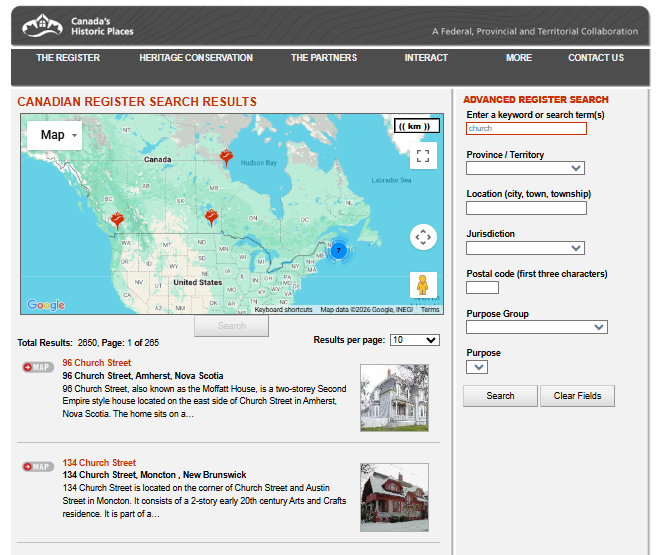
The Register allows users to search historic places across jurisdictions.
On March 25, CTV interviewed Wyatt on his efforts and why he felt saving the data was important not only to the heritage sector but to Canadians as a whole.
In addition to downloading the data, senior undergraduate students were tasked with standardizing it according to guidelines provided by HTNS, developed by their Built Heritage Researcher, Rudy Bartlett.
Emily McKenzie, a fifth-year student, had returned to SMU for an additional semester after completing her degree, hoping to gain extra credits and practical experience before pursuing a master’s in information studies. During her field placement, she focused on standardizing the downloaded data and conducting map searches to ensure no heritage building was overlooked. Reflecting on the project’s impact, she emphasized both its value and urgency:
“Especially here in Nova Scotia with our recent budget cuts, things are going to look different in the next couple of years, with resources and opportunities to create things like a database diminishing. To lend a hand and make that process easier for heritage professionals who won’t have access to the data otherwise is significant, and it’s important for us as students as well to have that real life experience.”

Emily McKenzie is a senior undergraduate student at St. Mary’s University in Halifax, NS. Photo Credit: Wyatt Hudson
Beyond their immediate efforts to preserve CRHP data, the project has given students a rare opportunity to contribute to work with real-world significance. What began as a class assignment quickly took on greater meaning, as students recognized the value of preserving a national resource at risk of being lost. As Wyatt put it, “This work feels a lot more meaningful because we’re contributing directly to the community and to heritage across the country. It carries more weight than a typical assignment; it’s not just a paper for a grade. It feels like we’re giving back in a real way and helping to preserve history, both here in Nova Scotia and across Canada.”
As of today, SMU students have successfully extracted all listings from the CRHP.
It is grassroots responses like these that speak to the impact and broader sense of urgency across the heritage sector, where organizations and individuals are grappling with how to safeguard critical information in the absence of a national system.
Provincial and Territorial Circumstances
The shutdown of the CRHP has highlighted the uneven nature of heritage record-keeping across Canada. Some provinces maintain robust provincial databases, while others rely heavily on the national register, leaving gaps when it becomes inaccessible and resulting in varying responses across regions.
Nova Scotia has no publicly accessible, digital, centralized provincial register and depends on the national system. Some provinces, including notably British Columbia and Quebec, have up-to-date, accessible provincial registers. Other provinces have registers in various states of completeness and accessibility. Some exclude municipal designations by design and all exclude national designations found within the province or territory.
For some provinces, collaboration seems to be the only way to move forward. In January 2026, leaders from heritage organizations in Nova Scotia, New Brunswick, PEI and Newfoundland and Labrador hosted a meeting to discuss how each would be addressing gaps in their own provincial databases as the shutdown approached, in an early effort to provide moral support to their neighbours.
PEI’s Heritage Officer, Sarah Bulman, noted how inter-provincial support and cooperation is going to be a key part in moving forward towards a new register and facing the ongoing challenges of maintaining heritage records without consistent national support. While PEI has a register, the province’s heritage team is cross checking with the CRHP data to ensure no registered heritage resource is left by the wayside.
“Collaborative federalism” lies at the heart of the Canadian Register. Since its establishment in 2004, much of the CRHP’s authority came from its collaborative framework (with leadership from Parks Canada) and the requirement that places listed be formally recognized at the national, provincial/territorial, or local levels. The CRHP emerged from the Historic Places Initiative (HPI), launched by the federal government with an approximate investment over four years, which included the development of the Register as well as the Standards and Guidelines for the Conservation of Historic Places in Canada, amongst other programs. This is a level of federal support which the heritage sector has not seen since. The initiative aimed “to improve the state of conservation in Canada and increase Canadians’ access to, and understanding of, their heritage by actively engaging them in its preservation.”
Former Canadian Registrar for Parks Canada Andrew Waldron noted in his public letter to the Minister of Environment and Climate Change, Julie Dabrusin, who is responsible for Parks Canada and therefore for historic places in Canada, how preserving these collaborative efforts is especially important in our current political climate:
“The CRHP has been the cornerstone of fostering a culture of heritage conservation through collaborative federalism – a facet of our democracy that is needed more than ever and has been demonstrated by your government.”
Collective effort is needed to protect Canada’s heritage in a way that is both comprehensive and resilient. While provinces and territories vary in the sophistication of their heritage records, the shutdown of the CRHP has underscored that no single jurisdiction can shoulder this responsibility alone.
The National Trust Responds
Since sounding the alarm in January 2026, the National Trust for Canada has taken decisive steps to address the fallout from the impending CRHP shutdown. Recognizing both the technical and governance challenges, the Trust launched a nationwide project in late February to explore options for a renewed register. Working with Claro Solutions, an IT consulting firm based in Victoria, BC, the initiative aims to assess the CRHP’s data, functionality, and management structures, while gathering insights from stakeholders across federal, provincial, territorial, and local levels.
Towards a Resilient Future for Canada’s Historic Places Register
Together, these efforts illustrate a collective commitment to safeguarding Canada’s heritage. The CRHP’s shutdown has exposed vulnerabilities in how historic places are documented, but it has also sparked unprecedented collaboration, innovation, and public engagement. As the heritage sector works toward a new, resilient, and inclusive register, it is clear that preserving Canada’s cultural memory will require not only data and governance, but the shared dedication of communities, professionals, and governments at every level. In the end, the response to this crisis may prove to be as important as the register itself, demonstrating that heritage conservation is truly a collaborative endeavor that depends on the people who value it most.