


Alarm as Canadian Register of Historic Places to Shut Down
The Canadian Register of Historic Places, better known as the historicplaces.ca website, is coming down. Parks Canada announced in late 2025 that the searchable database – a cornerstone for understanding heritage places in Canada – will be permanently unplugged in spring 2026. Heritage advocates are scrambling to save the data and find a replacement.
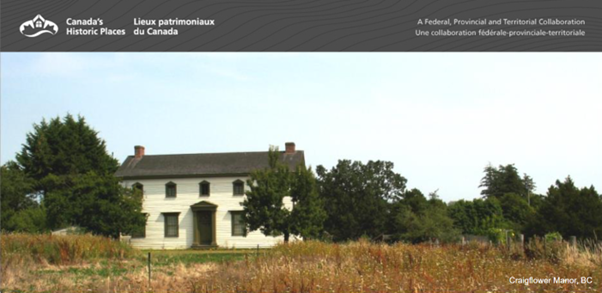
The Register includes historic places from across Canada. Photo credit: from historicplaces.ca
In December 2025, Parks Canada shared with provincial and territorial partners that the Canadian Register of Historic Places (the Register) would be taken down in spring 2026. The existing database is at the end of its technological life. There is no plan for its replacement.
The Register is an online searchable database of historic places in Canada which have been formally recognized for their heritage value by federal, provincial, municipal or territorial authorities. It is administered by Parks Canada and is publicly accessible on its dedicated website historicplaces.ca.
The Register was launched in 2004 as part of the Historic Places Initiative, a collaboration between the federal, provincial and territorial governments to improve protection of the country’s historic sites and to foster a culture of heritage conservation in Canada. The provinces and territories invested millions in creating the Register. Their initial response has been described as ‘shock and disappointment’.
There are approximately 13,500 historic places listed on the register. It is a vital tool for the heritage community and particularly for those jurisdictions who rely on it as the system of record for historic designations.
The impacts of the loss of the Register for the use and management of heritage in Canada are significant:
- The Register is used by federal, provincial, territorial and municipal officials and governments as a definitive source of information. It’s illustrated entries are used for public policy development, education, real estate proposals, investments, and private and public sector projects, and to assess potential designations, modifications, and demolitions.
- Without a common register, information about historic places will become more fragmented, inconsistent and difficult to find. Information will be lost or invisible to the Canadian public. Inconsistencies between registries will lead to confusion and gaps.
- The Register is the only Canadian tool that allows a search for listings across jurisdictions. Without it, any coordinated action or analysis for heritage places in Canada will be impeded.
Join Us as We Take Action
Decommissioning the Register creates an urgent need to salvage the information in the Register. In the longer-term, a solution to keep comparable information about historic places in all jurisdictions easily accessible is needed.
A download of their listings is being provided to each participating jurisdiction. These downloads, in the form of excel tables, do not include images. Work is underway in some provinces and territories by government officials and heritage organizations to ensure that critical information is saved.
The National Trust has written to the federal, provincial and territorial ministers responsible for the Register, calling on them to work together to ensure that comprehensive information about Canada’s historic places remains accessible to Canadians. We, along with our partners in the National Council, are ready to contribute to finding a contemporary solution that ensures on-going access to the Register’s rich information.
If you use the Canadian Register of Historic Places, write to the federal Minister of the Environment (ministre-minister@ec.gc.ca) and to your provincial or territorial minister responsible for heritage (see list below) to let them know that you care about what is being thrown away.
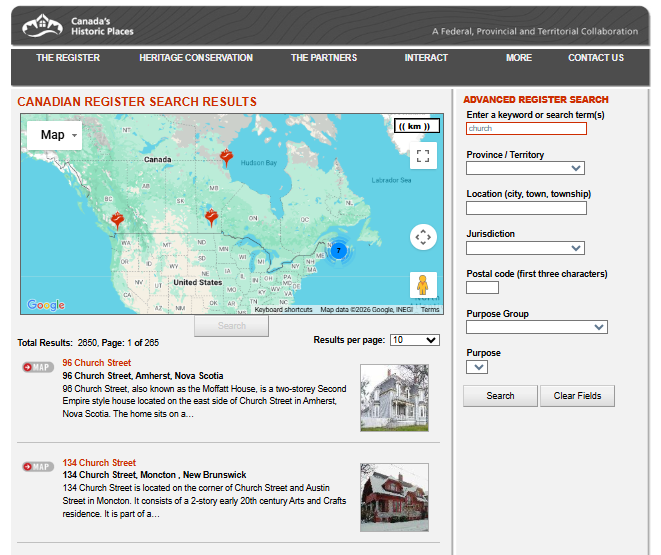
The Register allows users to search historic places across jurisdictions.
Federal Minister Responsible for Heritage and Parliamentary Secretary
- The Honourable Julie Dabrusin, Minister of Environment, Climate Change and Nature: ministre-minister@ec.gc.ca
- The Honourable Wade Grant, Parliamentary Secretary to the Minister of Environment, Climate Change and Nature: wade.grant@parl.gc.ca
List of Provincial and Territorial Ministers Responsible for Heritage
- Newfoundland and Labrador – The Honourable Andrea Barbour, Minister of Tourism, Culture, and Arts: TCARMinister@gov.nl.ca
- Nova Scotia – The Honourable Dave Ritcey, Minister of Communities, Culture, Tourism and Heritage: MIN_CCTH@novascotia.ca
- Prince Edward Island – The Honourable Zack Bell, Minister of Fisheries, Tourism, Sport and Culture: MinisterFTSC@gov.pe.ca
- New Brunswick – The Honourable Isabelle Thériault, Minister of Tourism, Heritage and Culture: isabelle.theriault@gnb.ca
- Québec – The Honourable Mathieu Lacombe, Ministère de la Culture et des Communications: ministre@mcc.gouv.qc.ca
- Ontario – The Honourable Graham McGregor, Citizenship and Multiculturalism: graham.mcgregor@ontario.ca
- Manitoba – The Honourable Nellie Kennedy, Minister of Sport, Culture, Heritage and Tourism: minscht@manitoba.ca
- Saskatchewan – The Honourable Alana Ross, Minister of Parks, Culture and Sport: minister.pcs@gov.sk.ca
- Alberta – The Honourable Tanya Fir, Minister of Arts, Culture and Status of Women: acsw.minister@gov.ab.ca
- British Columbia – The Honourable Anne Kang, Minister of Tourism, Arts, Culture and Sport: TACS.Minister@gov.bc.ca
- Yukon – The Honourable Jen Gehmair, Minister of Tourism and Culture: TACS.Minister@gov.bc.ca
- Northwest Territories – The Honourable Caitlin Cleveland, Minister of Education, Culture and Employment: Caitlin_Cleveland@ntassembly.ca
- Nunavut – The Honourable Brian Koonoo, Minister of Culture and Heritage: bkoonoo7@gov.nu.ca