

Change Agents: Canada’s New Wave of “Heritage” Developers – Part 2
Like the first Change Agents article in July 2025, Part 2 seeks to capture the new spirit of an up-and-coming generation of developers capitalizing on heritage buildings and quietly remaking Canada’s real estate development scene.
But what is a “developer,” really? The dictionary definition is, “a person or company that buys land or buildings in order to build new houses, shops, etc. or to improve the old ones, and makes a profit.” This definition seems too narrow. Many projects are the result of actors – consultants, community land trusts, governments, etc. – who are often out of sight but no less influential and visionary. Here are three organizations instigating or shepherding brave heritage transformations across Canada.
Fisher River Cree Nation (Winnipeg, Manitoba)
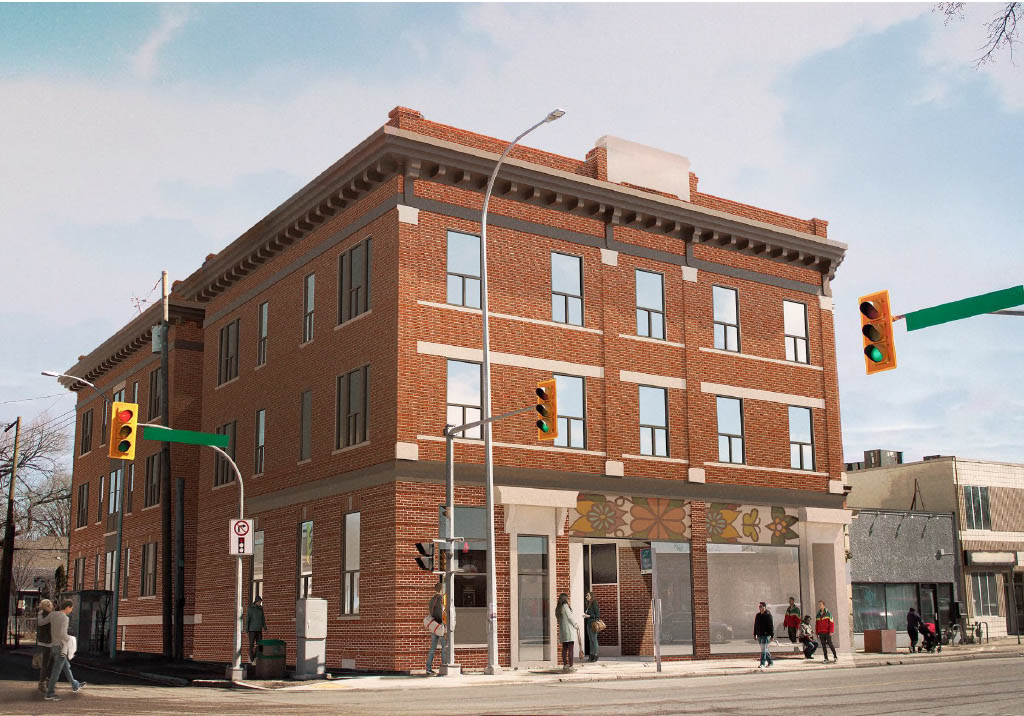
A rendering of the First Nation Healing Centre, set to open in Fall 2026 – Credit: AtLRG Architecture Inc.
“We call our building Kapāpak, which is butterfly in Cree,” says Katina Cochrane, Executive Director of First Nation Healing Centre about Winnipeg’s former Rubin Block. “Our vision was to create a place where residents can feel protected and nurtured, like a cocoon, and eventually emerge as beautiful butterflies.” It is a wonderful metaphor amplified by the fact the building itself has undergone a breath-taking metamorphosis. Placed on the National Trust’s Endangered Places list in 2019, the Rubin Block, a 3-storey mixed use building from 1914 on Winnipeg’s South Osborne Street, had stood vacant, boarded up, and fire-damaged since 2014. In September 2026, after a two-year, $17.8 million transformation, the Healing Centre will welcome the first residents to its 13 housing units, for women and their children, many escaping domestic violence and transitioning to urban life in Winnipeg.
The rehabilitated building will have community gathering space, a shared kitchen, daycare, laundry facilities, and there will be on-site programming and round-the-clock staff in one of the building’s storefront commercial spaces. Workers will help people find independent living spaces after they reach the residency limit. The facility will be shepherded by an all-woman governance board.
“If you look at the stories of the missing and murdered Indigenous women in Winnipeg, most of them had just re-located to the city,” Cochrane explains. “When people move to the city they lose their support systems. On top of that, social assistance on reserve is through the federal government, and there is often a gap as they shift to the provincial social system. All this leaves them very vulnerable.”
Fisher River Cree Nation has offered women shelter services for over 30 years in their community 200 kms north of Winnipeg and had recently expanded it. So when a wave of new federal funding for housing was recently released, Healing Centre leadership thought it would be a great opportunity to build something in Winnipeg where many community members lived. When they hesitated due to the complexity and risk, Chief David Crate and Council pushed them to take on the challenge,
Finding a safe neighborhood was crucial. “We looked at buildings in 22 other Winnipeg locations, but we loved this heritage building, the neighborhood with its parks and canoe club, and good schools,” says Cochrane. “Historically Indigenous peoples have not been welcomed in these kinds of middle-class areas. There are no other Indigenous organizations in Riverview [the area where the Rubin Block is located]. But we thought of it as an act of Reconciliation to locate here and help families heal.”
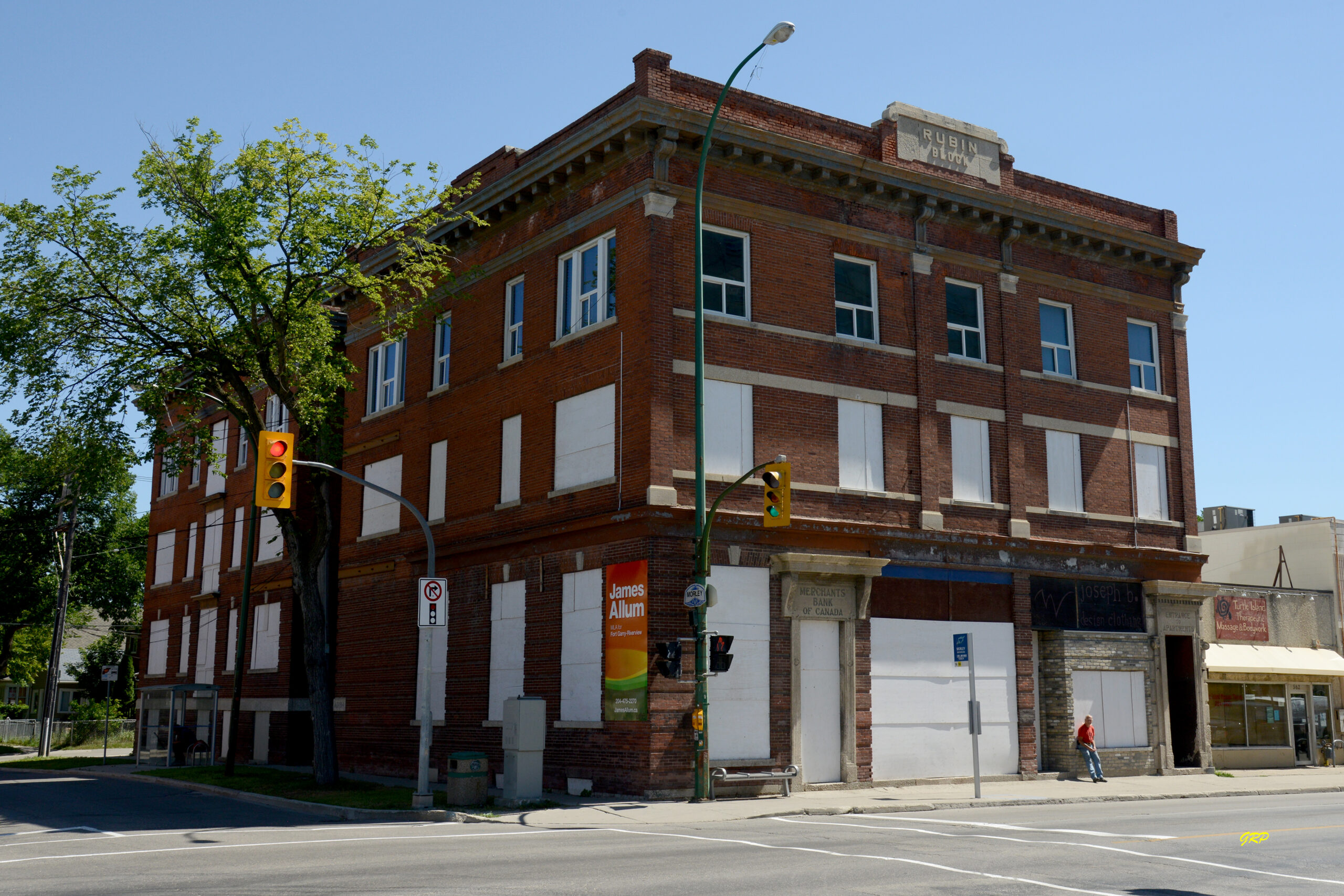
The Rubin Block in 2019 when it first appeared on the National Trust Endangered Places List – Credit: George Penner.
Cochrane is excited about the quality of the rehabilitated building. They are leaving exposed brick in many places, and salvaged pressed tin ceiling tiles from the old bank space to reuse as a feature wall. A former lightwell in the residential section was cleverly repurposed as an elevator shaft. They also worked hard to integrate traditional teachings into its creation. For instance, when they learned that someone had died in the building many years before, an Elder conducted a traditional pipe ceremony, buried tobacco under the building, and blessed the construction workers.
“We envision a welcoming place where residents can have feasts, and overcome their culture shock,” Cochrane explains. With this in mind, they have introduced a special round room into the Rubin Block so community members can gather in a more traditional style of space. The Healing Centre is also making their public presence felt by installing works by two Anishinaabe artists: Jordan Stranger and Storm Angeconeb.
It was initially daunting to pull together the $17.8 million in funding required for the project from federal, provincial, and municipal sources. Cochrane and her Fisher River team received indispensable help strategizing, navigating the funding sources, and creating a pro forma [a financial tool used to assess whether a real estate project is viable] from the non-profit University of Winnipeg Community Renewal Corporation 2.0, underscoring the gaps underserved communities face when launching into development projects. With vision and determination, it all fell into place, and a grand opening for the Healing Centre will take place in September 2026.
Dunefield (Vancouver, BC)
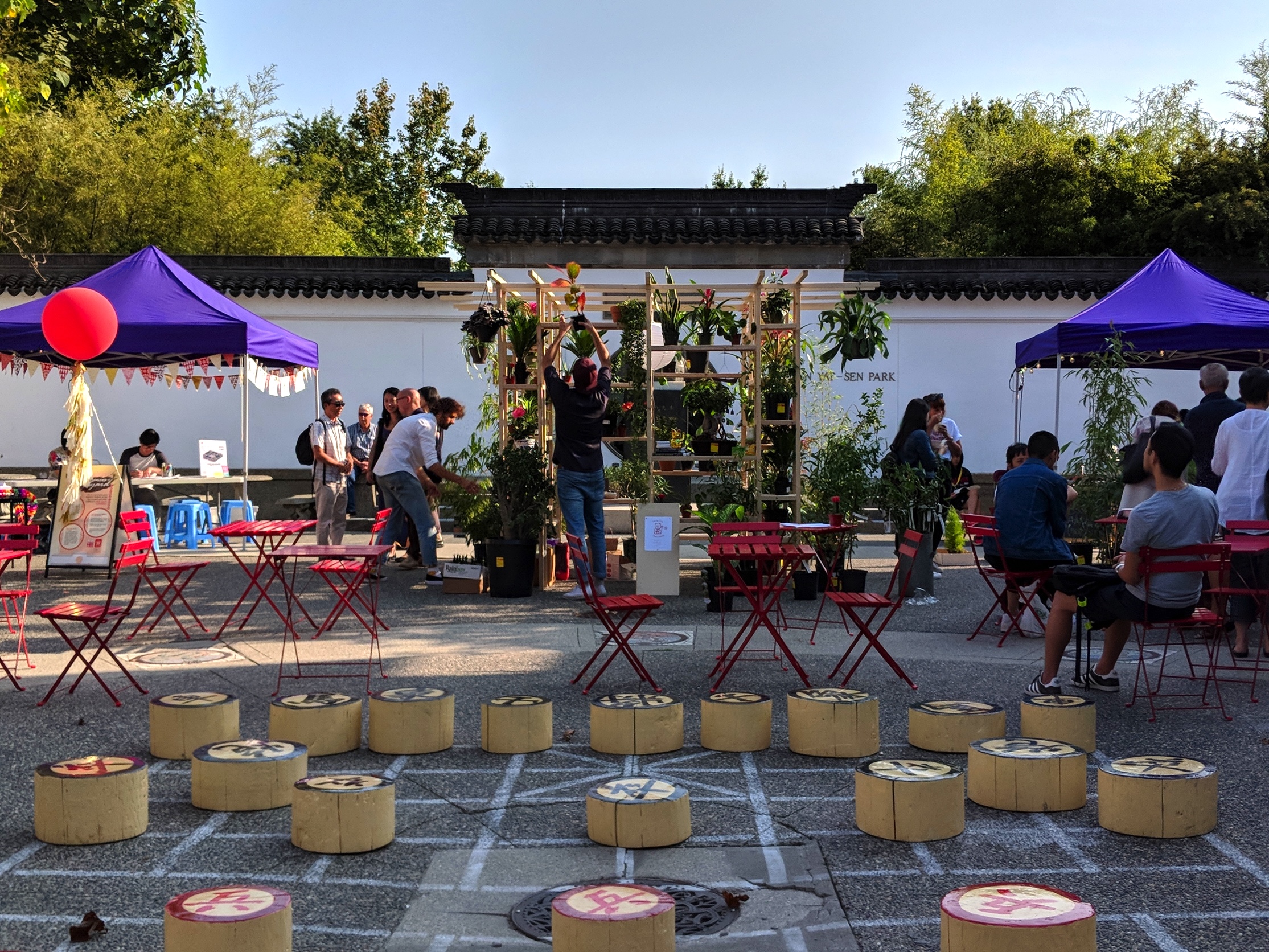
Vancouver Chinatown placemaking and engagement session at Dr. Sun Yat-Sen Memorial Courtyard. Credit: Dunefield
Dating back to the early 1880s, Vancouver’s Chinatown is the third oldest in North America. What sets it apart is that it has retained over 50 of its historic clan associations and benevolent societies – for instance the Cheng Wing Yeong Tong Society or Wongs’ Benevolent Association – and about a dozen of these are located in Chinatown heritage buildings. Established by early immigrants to provide social services and residential space to their members, these historic institutions have played a critical role in sustaining community life, legacy businesses, and the intangible heritage of the area.
Even so, by the 2010s things looked bleak for Vancouver’s Chinatown: condo tower speculation threatened its historic buildings, long-time residents were leaving, and its once vibrant street life was fading. Jump cut to 2026 and things are turning around: planning changes and heritage protections are having an impact, new businesses opening, buildings being rehabilitated. The area is getting its mojo back.
One of the quiet movers and shakers has been the small Vancouver-based community development consultant, Dunefield. Launched in 2011, they have built up an impressive body of work helping ethnocultural communities, businesses, and residents through periods of change. “I often describe our work as ‘enablers’ or ‘teambuilders,’” explains Dunefield Principal Wilco van Bemmel. “Some groups have so little capacity, they need a navigator.”
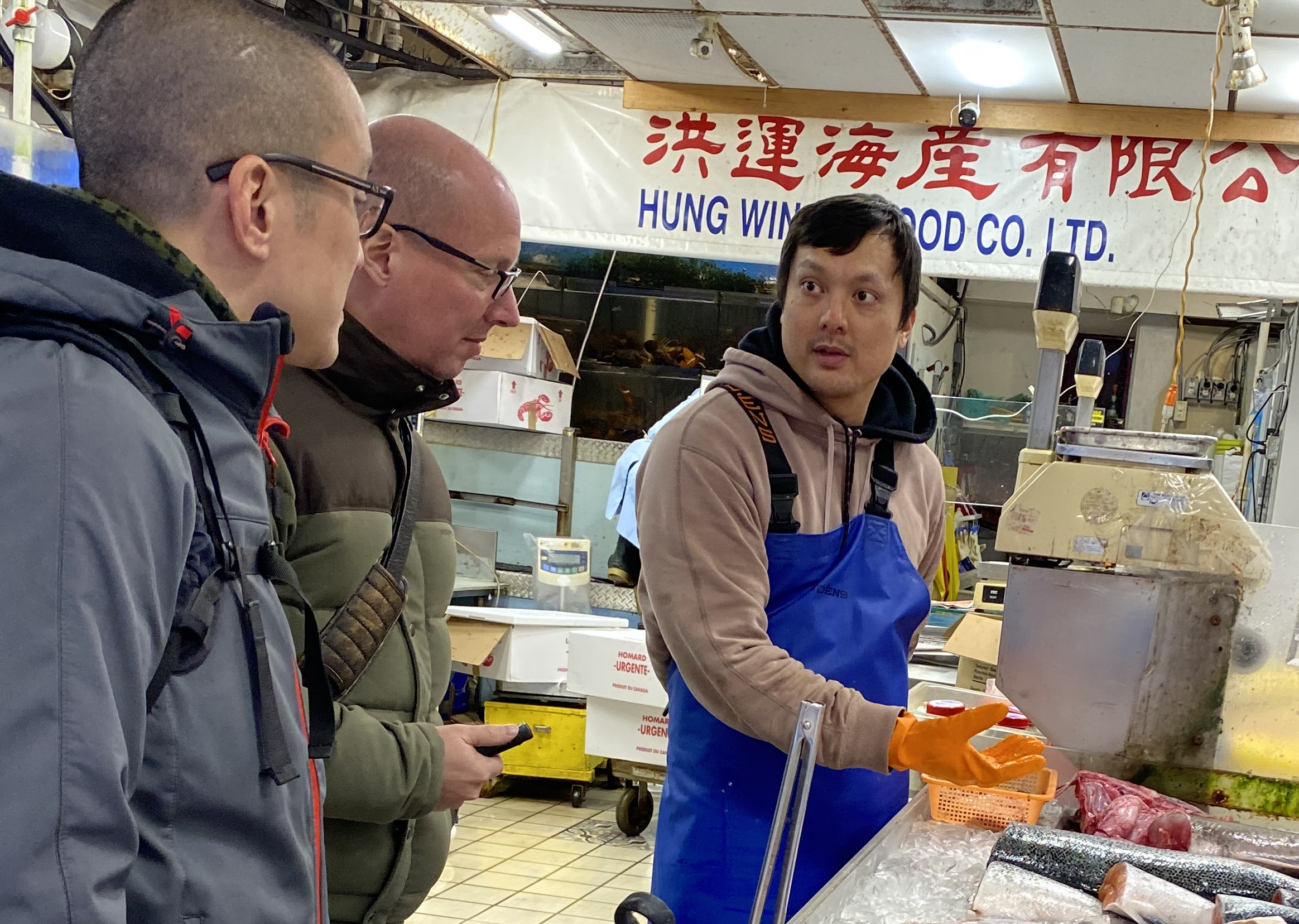
Listening to local legacy business owners, Wilco van Bemmel (centre). Credit: Dunefield.
Dunefield originally got involved in Chinatown in 2017 through Youth Collaborative for Chinatown (YCC) [see Place-Keeping in Vancouver’s Chinatown (2020)] who were trying to help keep the historic restaurant Kam Wai Dim Sum alive. Inherited by a son and daughter who had never thought of running the family restaurant, the new owners changed their minds and gained confidence after exploring possibilities with Dunefield and YCC. Wilco and his team worked with them for over two years, assisting with redesigning the restaurant space, getting building permits, raising funds, and much more. The revival of Kam Wai Dim Sum opened the eyes of other young entrepreneurs in Chinatown, helping them see what was possible. Dunefield went on to work with other societies like the Chinese Nationalist League and Wong Society to find them culturally appropriate renters.
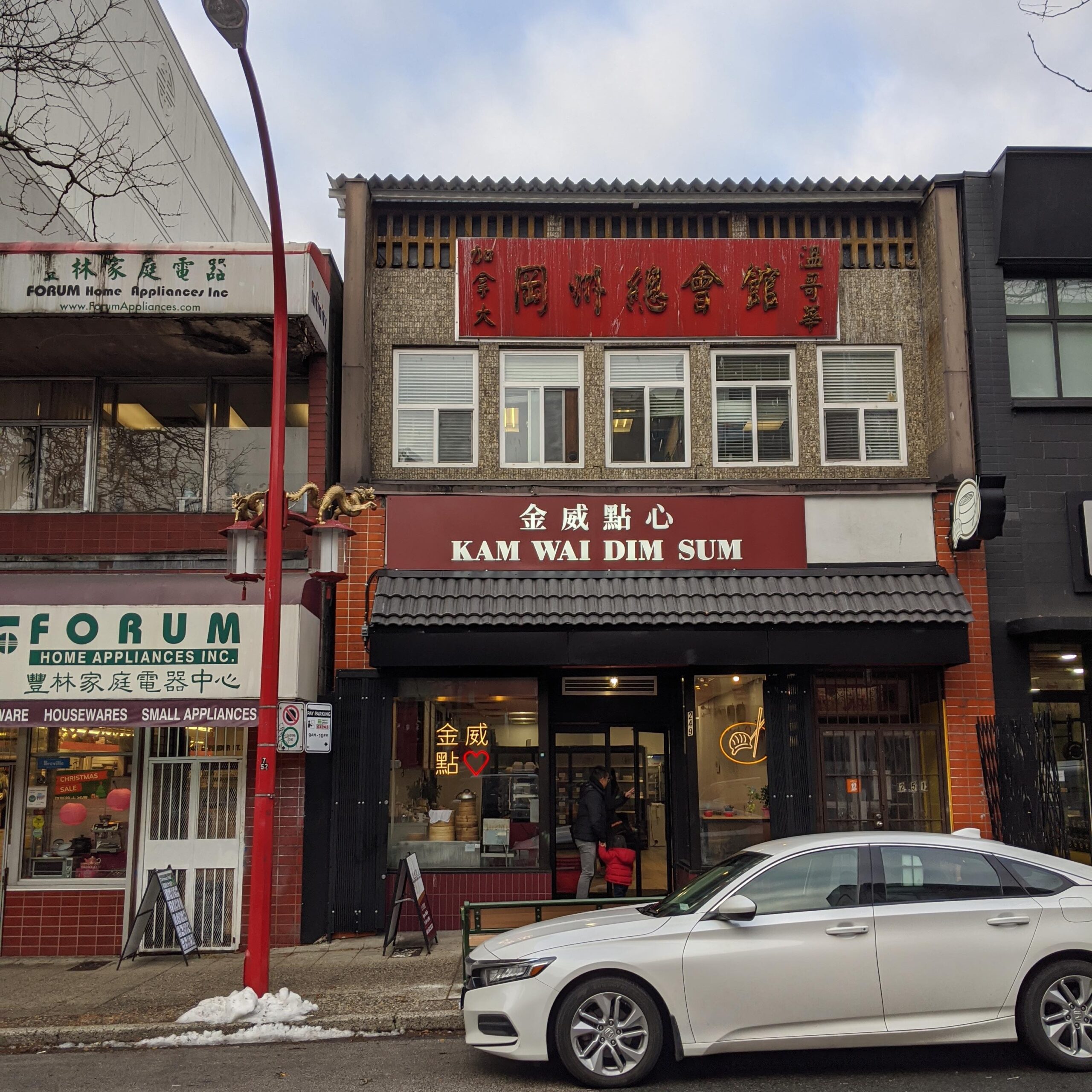
Revitalized Kam Wai Dim Sum store in the Kong Chow Society Building. Credit: Dunefield.
Over the last few years, Dunefield has been working with the Vancouver Chinatown Merchants Association (VCMA) to revive the Plaza Building, a 1995 shopping mall and the only large indoor space in Chinatown. VCMA members had hopes for a revitalization of the Plaza Building and area after the municipal heritage district designation, and to make that happen they approached Dunefield to generate a new vision. Similarly, their Stewardship of Chinatown Society Buildings Project has been working to encourage practical collaboration between members of the Chinatown Society Heritage Buildings Association to sustain their historic structures, creating tools for asset analysis and maintenance, unlocking access to community impact capital, and developing a long-term vision and growth path.
For Wilco and his team, what drives them isn’t achieving ownership, but rather the satisfaction that comes from seeing things happen that couldn’t happen on their own. “We see causes and get excited about what is possible,” Wilco says. “If I listen to communities their dreams don’t sound outrageous, but rather very doable interventions and strategies to rally around for a time. No one in Dunefield is leading, we play a humble role, but together with our partners, we pull off things that are remarkable.”
Sidewalk Real Estate & Development (Halifax, NS)
“Our firm sees heritage as an opportunity not a constraint,” says Joe Nickerson, Vice President & Partner at Sidewalk Real Estate & Development in Halifax. “Developers as a whole need to not fight heritage but work with it. At Sidewalk we want to prove that old buildings can thrive if we approach them in a creative way with sound business logic.”
Since its creation in 2017, Sidewalk has quickly built up a remarkable body of adaptive reuse and heritage work leveraging a wide variety of building types: from industrial warehouses to single family homes to office towers. But it always comes back to context for Nickerson and the Sidewalk team: “We are a neighbourhood first developer, which means we’re focused on the context of the entire area in how we approach a project. We believe every neighbourhood has its own soul, its own feel, which is an intangible thing that’s impossible to recreate from scratch. And this has naturally drawn us to an adaptive reuse and heritage approach.”
Purchased in 2017 and opened in 2019, Sidewalk’s first project, dubbed Tel Lofts, created 24 units in a plain-looking brick 1950s era Maritime Tel & Tel Storage building. Playing to the strengths of the building’s utilitarian architecture, its structure was exposed and imperfections celebrated with the project eventually winning a Halifax Urban Design Award. For Sidewalk, this project proved the economic viability of reuse and spurred them to go bigger. “We are not a not-for-profit or reliant on any government grant funding, so we need to make projects work independently of any funding. We have shown that if you take a proforma focused approach you can actually save and retain the core heritage elements of buildings and give them a new useful life for another 50 or 100 years.”
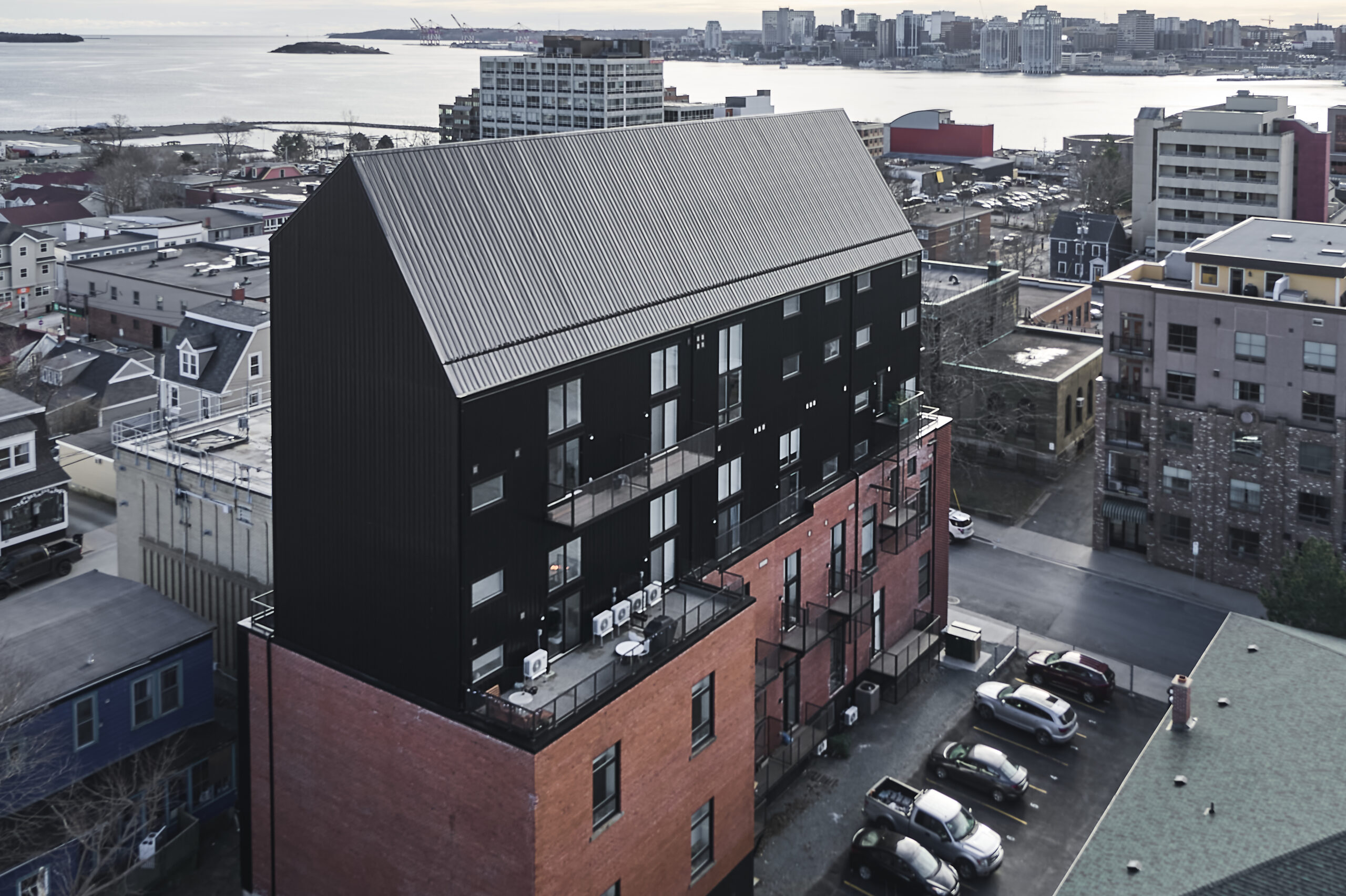
Tel Lofts, Sidewalk RED’s first project, transformed an unremarkable 1950s telecommunications building into an award-winning housing project – Credit Julian Parkinson.
In 2019, Sidewalk purchased a Brutalist 1975 hotel in the same downtown Dartmouth neighbourhood. With “minimal demolition and maximum creativity,” they created 81 micro- units in a building that had 69 hotel rooms, retaining the huge amount of embodied carbon in the structure. It opened in January 2024 as The Shuffle.
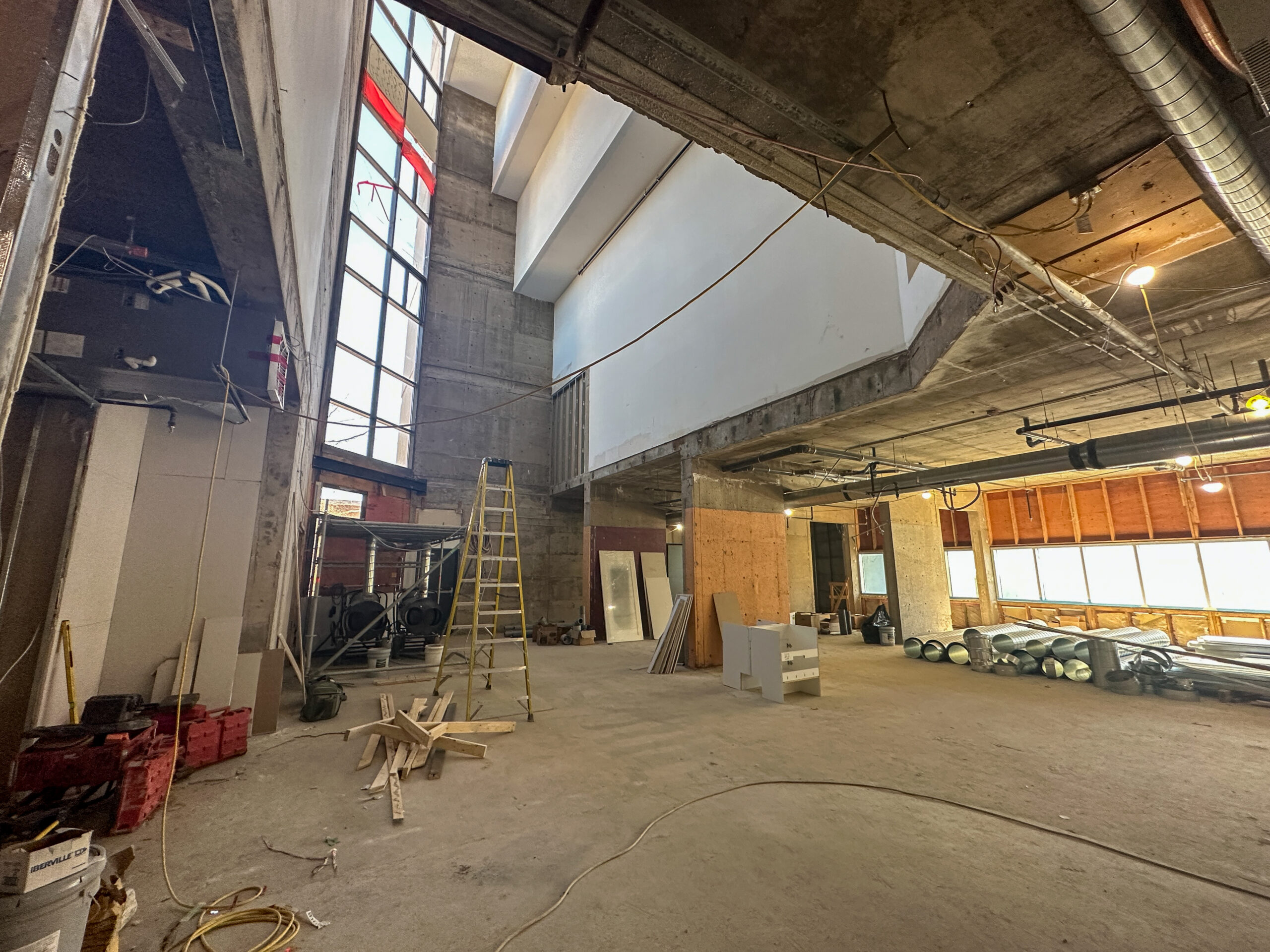
The Shuffle, seen here during construction, created 81 micro-suites in a rundown brutalist hotel, opening up a monumental lost atrium in the process. Credit: Sidewalk RED.
The Agency Art Lofts project in downtown Halifax took Sidewalk to another level and became Halifax’s first hard loft conversion. Purchased in 2021, they converted the 13-storey 1960s Centennial Building into 173 residential units. When Sidewalk purchased the building many counselled them to follow the lead of the condo project across the street which first demolished a former federal building. When they examined the Centennial Building, however, and saw it had “amazing bones” and great adaptation potential — with its high ceilings and structural concrete quality that would never be found in contemporary structures – they embraced the office to housing conversion. By upcycling the core structure alone, the saved 8,000 tonnes of embodied carbon. Agency Art Lofts opened in summer 2025 while the demolition and new build project across the street is years from completion. In other words, reuse creates housing faster.
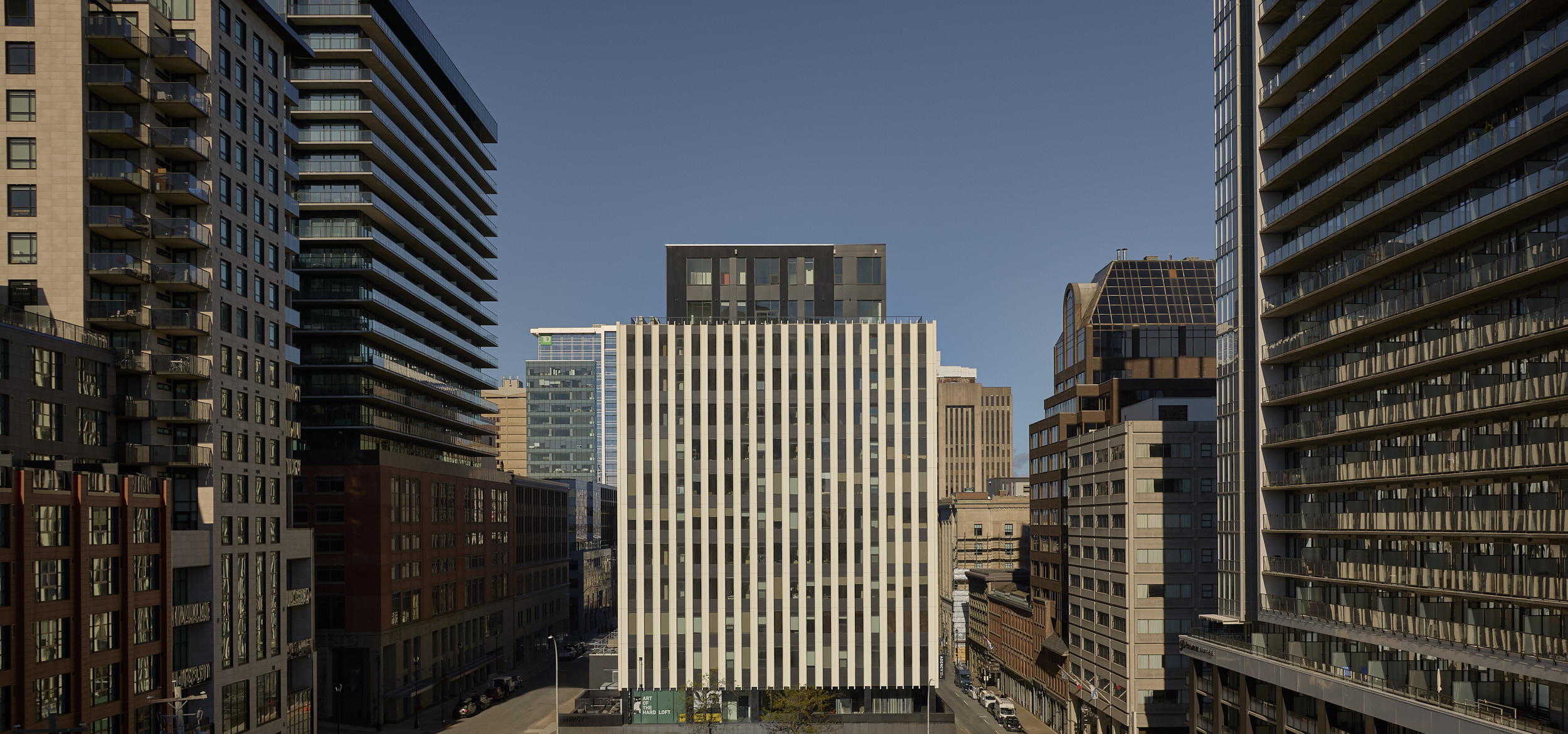
Sidewalk’s Agency Art Lofts (centre) project in downtown Halifax created 173 housing units in 1967 office building in record time and saved 8,000 tonnes of embodied carbon in the concrete structure alone. Credit Julian Parkinson.
One of the firm’s latest project involves the United Memorial Church (added to the National Trust Endangered List in 2019) in Halifax’s North End. The previous owner was set on demolishing the church, but Sidewalk talked them into selling it and then promptly obtained a heritage designation. Given the extreme disrepair of the church Nickerson says they will need to add a 12-storey tower on the site to make the project viable.
“Heritage is a foundation in our communities,” says Nickerson. In the current push for housing and development, however, if heritage efforts aren’t supporting those priorities, heritage places will be lost. “There is a need for the heritage community and development community to meet in the middle and find common ground,” reflects Nickerson. “When you marry the two, you can create viable projects and sustain more of these buildings. The reality is our cities are growing and these low-rise heritage buildings will not be viable, and will be knocked down in favour of height, unless we can work together.”
Do you know an “amazing developer” who is making a difference for heritage places? We would love to hear about them at nationaltrust@nationaltrustcanada.ca