

Kettle Valley Steam Railway, the Doukhobors, and an Unsolved Mystery
History doesn’t exist within a vacuum, and historic sites across Canada share connections with one another either through their shared history, story, artifacts and people, or town. The Doukhobor Dugout House, Doukhobor Discovery Centre, and Kettle Valley Steam Railway are just one example of how historic sites are connected to one another, and it’s a story of exile, community, and one of Canada’s great unsolved mysteries.
Doukhobors are an ethnoreligious group from Russia. Believing that the Spirit of God exists within each living being, they dissented from the Russian Orthodox Church and are known for their practice of radical pacifism. In Russia, they rejected the church’s liturgy, embraced communal living, replaced the Bible with orally transmitted psalms and hymns, and did not make use of any religious symbols. As one might expect, rejection of the church’s teachings was not taken lightly, and in the late 18th century Doukhobors were persecuted by Russia’s tsars and Orthodox church for heresy and pacifism. At the end of the 19th century, their spiritual leader Peter Verigin was arrested and sent into exile in Siberia.
Did you know? The term Doukhobor means “spirit wrestler” and comes from an Orthodox archbishop in 1785 who intended it to mean “Wrestlers against the Holy Spirit.” However, when the Doukhobors adopted the name they interpreted it as “Wrestlers for and with the Spirit.”
Persecuted in Russia, the Doukhobors sought safety elsewhere. With the help of author Leo Tolstoy (yes, that Leo Tolstoy who wrote War and Peace and Anna Karenina and many other great novels), 7,500 Doukhobors sailed to Canada in 1899 with many of them settling in what would later become Saskatchewan. In 1902, 500 more Doukhobors accompanied spiritual leader Peter Verigin to Canada.
In 1908, Peter Verigin led many of his followers to the Kootenay Region of British Columbia where 6,000 of them lived and farmed in a self-contained community. The community sustained itself through logging and growing fruit in orchards. The Doukhobors continued to live by their pacifist values, including staging a boycott of British Columbia public schools when militia and rifle training was introduced to the curriculum.
In 1915, the Kettle Valley Steam Railway opened as a subsidiary of the Canadian Pacific Railway. It was built in response to the growing mining demands in the Interior region of British Columbia and, like the railways in many parts of British Columbia and Canada, contributed to the economic growth and settlement of the region.
On October 29, 1924, Verigin boarded a train bound for the Doukhobor community at Grand Forks, accompanied by 20-year-old Mary Strelaeff and newly elected MLA for Grand Forks John McKie. Just after one in the morning, right after leaving Farron, an explosion ripped through the train tearing it apart. Out of the 21 passengers, all but two were killed or injured. Verigin’s body was found 15 metres away. Almost immediately, it was speculated that the explosion was the result of a plot against Verigin, and members of his own community were suspected. Investigations revealed the remains of an Italian clock wired to a battery that had been blown almost 75-metres away from the car as a result of the blast.
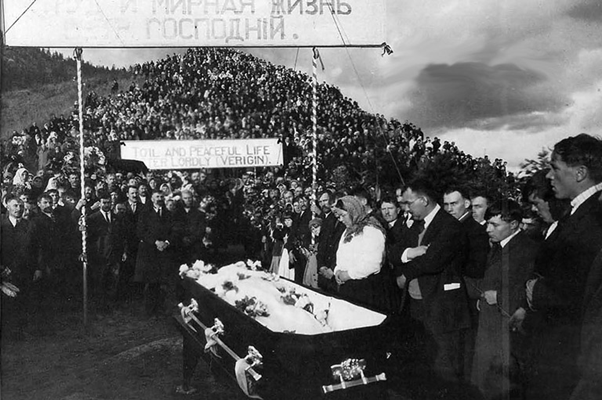
The funeral of Peter Verigin attracted about 7,000 mourners. Courtesy of Simon Fraser University Library.
The investigation into Verigin’s death continued even into the 1960s when the RCMP would explore the possibility that Peter Petrovich, Verigin’s son, was behind the explosion. In 1963, the RCMP would conclude that there was too little evidence to confirm or refute this theory. To this day, the case remains unsolved.
Today, about 30,000 Canadians are of Doukhobor descent. Sites like Doukhobor Dugout House in Blaine Lake, Saskatchewan and Doukhobor Discovery Center in Castlegar, BC are trying to share the story of a people who came looking for peace in Canada and connect Canadians with Doukhobor culture, history, and heritage.
Doukhobor Dugout House, Blaine Lake, SK
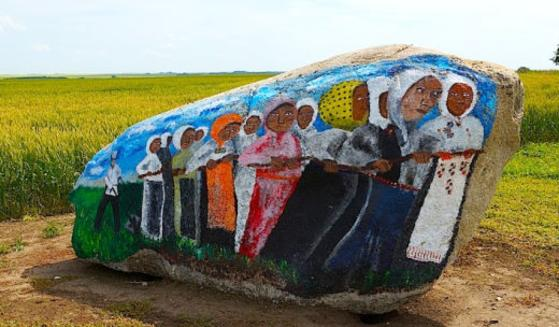
Painting of Doukhobor women pulling a plow at Doukhobor Dugout House. Plow pulling was a traditional agricultural method practiced by the Doukhobors. Courtesy of Doukhobor Dugout House.
The dugout house in Blaine Lake was built by Russian Doukhobors in 1899 and is the only known surviving example of this kind of temporary shelter in Canada, bringing attention to the hardships faced by the Doukhobors. The site contains ten areas of historical significance, including the two dugout houses on site. Visitors can enjoy a slice of freshly baked Doukhobor bread, explore the museum which contains artifacts from the site, and trace the community’s journey of survival and resilience. Adding to the intrigue, the site also hosts an evening event called After Dark Mystery, which delves into the unsolved murder of Doukhobor leader Peter Verigin.
https://www.doukhobordugouthouse.com/
Doukhobor Discovery Centre, Castlegar, BC
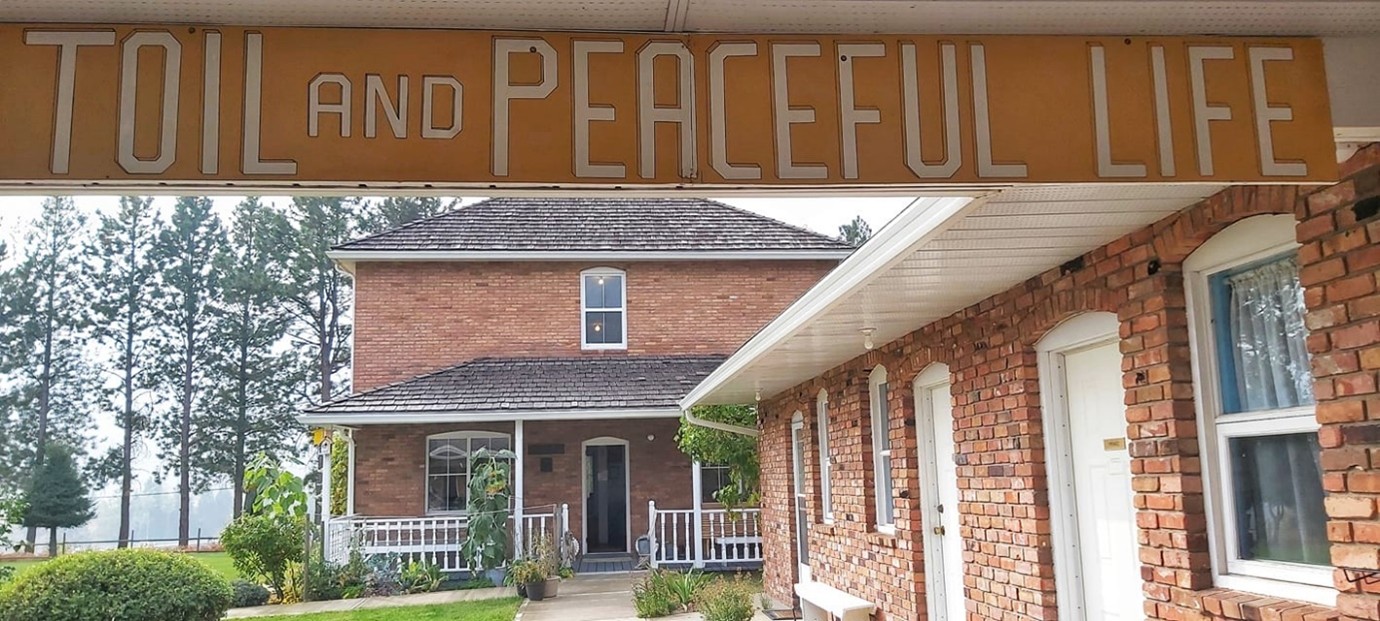
“Toil and peaceful life” was a slogan the Doukhobors lived by, embodying their core values. Courtesy of Doukhobor Discovery Centre.
Doukhobor Discovery Centre was opened in 1971 after the Doukhobor community in Kootenay committed themselves to preserving Doukhobor culture. Across 10 buildings, visitors can explore a heritage orchard and enjoy Doukhobor cuisine at the restaurant along with 1,600 artifacts.
https://www.doukhobor-museum.org/
Kettle Valley Steam Railway, Summerland, BC
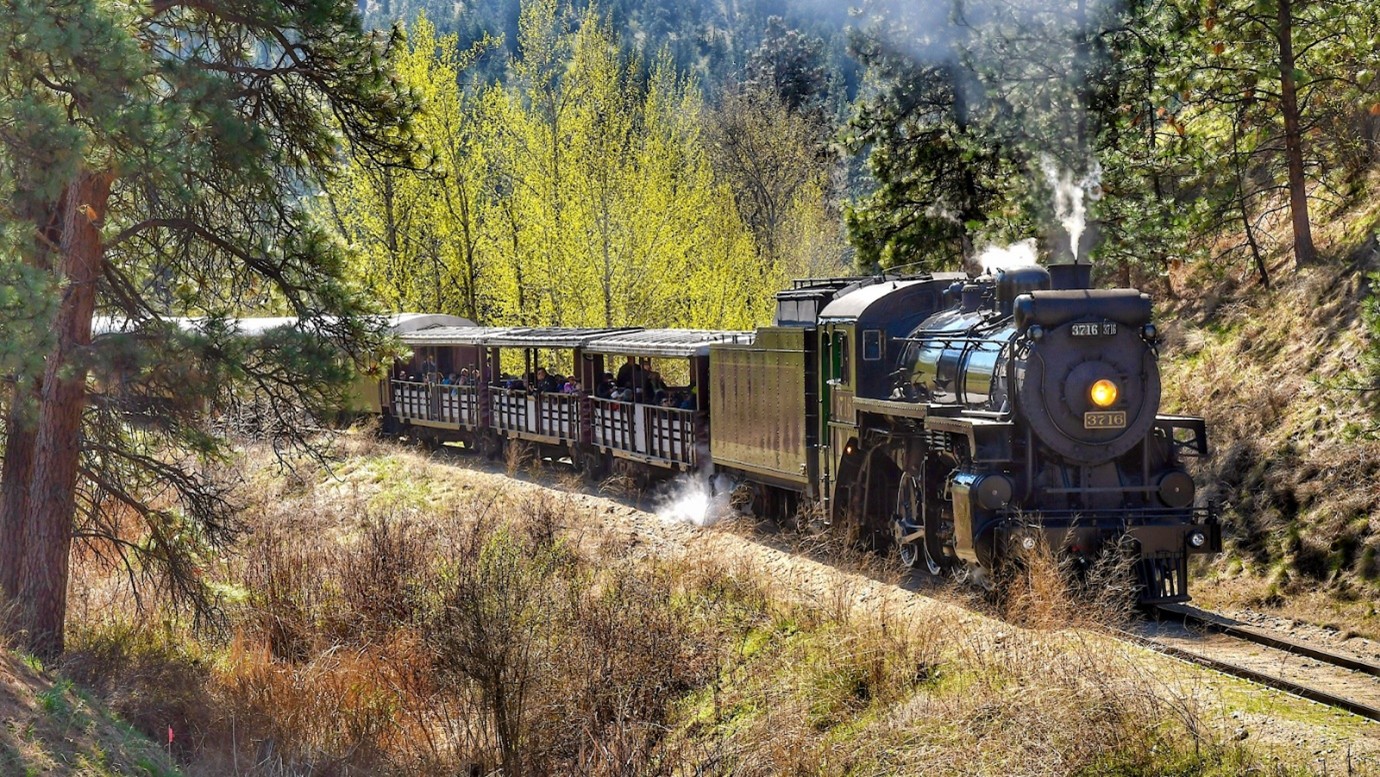
Courtesy of Kettle Valley Steam Railway.
It was on the Kettle Valley Railway that Verigin died almost 100 years ago. Running from Faulder to Trout Creek, the Kettle Valley Steam Railway takes riders aboard a historic locomotive on the only remaining section of the Kettle Valley Railway through orchards, vineyards, over the 73-metre-tall Trout Creek Trestle, and through some incredible vistas. They also offer immersive rail experiences, including Murder on the Tracks and a Mother’s Day train.
https://www.kettlevalleyrail.org/