



Do you Copy? Recreating Marconi’s Historic 1901 Signal for Historic Places Days 2026
On July 11, 2026, the National Trust for Canada officially launched this year’s Historic Places Days (HPD) campaign with a video message that travelled across the country — and across more than a century of history.
Created around this year’s theme, Communication Through Place and Time, the launch video brought together two historic places separated by more than 2,000 kilometres: Signal Hill National Historic Site in St. John’s, Newfoundland and Labrador, and the Diefenbunker in Carp, Ontario.
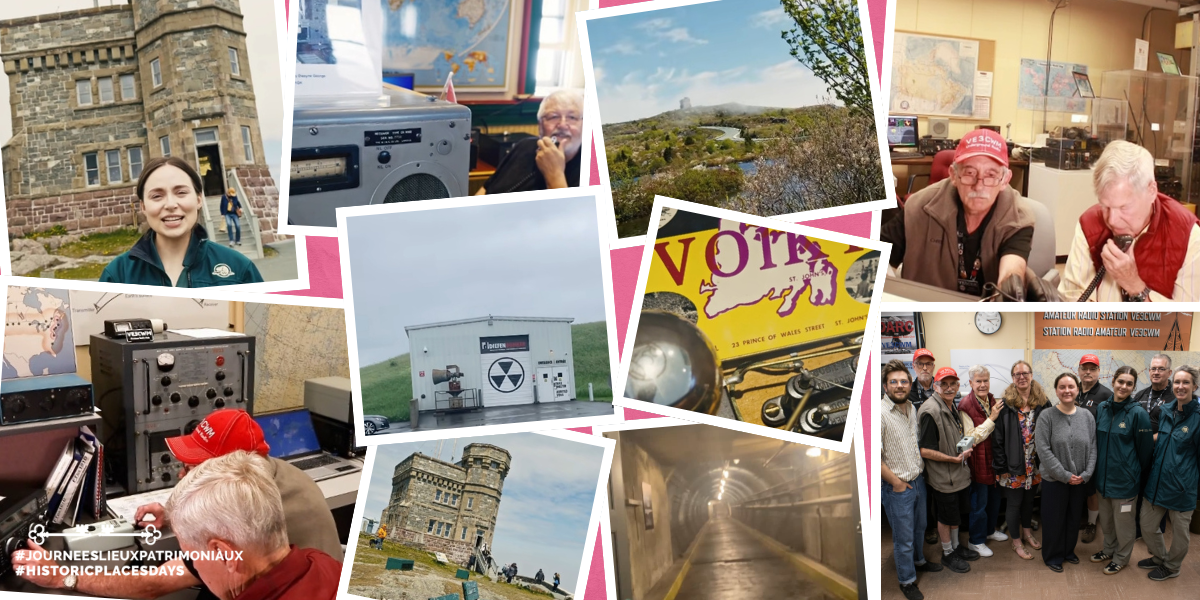
Noah Jake Bender, a local artist and videographer from St. John’s, Newfoundland, captured scenes outside of Cabot Tower as well as the radio transmission for this video. Videos captured at the Diefenbunker were taken by Bennette Malcolmson, Marketing and Content Coordinator at the Diefenbunker. Videos captured outside the Diefenbunker were taken by National Trust staff.
The connection between these two places was inspired by an event that took place at Signal Hill 125 years ago. In December 1901, Italian inventor Guglielmo Marconi and his team gathered near the site’s famous Cabot Tower to receive a wireless signal transmitted across the Atlantic from Cornwall, England. The successful reception marked a major moment in the history of wireless communication and helped demonstrate that messages could travel across the Atlantic without physical wires.
For Historic Places Days 2026, we wanted to bring that story into the present day. The National Trust and Parks Canada worked with members of the Society of Newfoundland Radio Amateurs (SONRA) and the Diefenbunker’s longtime volunteer radio operators who recreated the circumstances of Marconi’s experiment — this time by sending a wireless message between Signal Hill and the Diefenbunker.
The goal was to use a historic form of communication to create a new connection between two historic places. At Signal Hill, SONRA volunteers transmitted the message using their radio equipment, while volunteers at the Diefenbunker received it in Carp, near Ottawa.
Since the first signal received at Signal Hill was not a voice heard over a radio broadcast, but Morse code, that is where our message started.
Three short dots: the Morse-code letter S. The signal was chosen because it’s simple, distinctive pattern made it easier to distinguish from background interference. Click. Click. Click.
From 1901 to 2026 –Reflecting on 125 Years of Connection
More than 125 years separate Marconi’s experiment at Signal Hill from the Historic Places Days 2026 recreation. Yet the basic idea remains the same. As humans, connection is key. Throughout history, we have found countless ways to connect with one another across distances and across time.
In 1901, people gathered at Signal Hill to listen for a signal many believed could not cross the Atlantic. In 2026, radio amateurs and volunteers at two historic places thousands of kilometres apart listened for those same three dots.
The technology has changed dramatically, but both Signal Hill and the Diefenbunker tell stories about the ways communication and technology have shaped Canada — from 18th-century military and maritime history to the Cold War. Bringing these two places together offered a way to make those connections visible and to demonstrate how historic places can be active spaces for learning, participation, and connection.
Volunteer Collaborators
This recreation depended on collaboration just as much as it depended on radio technology. At Signal Hill SONRA volunteers brought their knowledge of amateur radio and their equipment to the project, working alongside Parks Canada staff at the National Historic Site. At the Diefenbunker, a dedicated group of longtime volunteers — many of whom have been involved with the museum for decades — operated the receiving station and helped make the connection possible.
The success of the project was a testament to the knowledge, enthusiasm, and generosity of everyone involved. Many thanks to the following for their contributions:
Signal Hill:
Doug Mercer (VO1DM), President of SONRA
Chris Vernon, (VO1CH) (Operator)
Aaron Abbott (VO1IV)
Darrell Steele (VO1MDS)
Bob Evans (VO1RE)
Diefenbunker:
Robert Boyd (VE3BE) (Voice communication)
Chris Bisaillion (VE3CBK) (Morse code communication)
Gord Heath (VE3IRC)
Scott Hendry (VE3NPX)
Thane Brown (VA3TTM)
Watch the Behind-the-Scenes from our video shoots at both Signal Hill and the Diefenbunker