




Heritage Day in Canada: Past and Future of a National Celebration
Heritage Day, which falls on the third Monday in February, is an annual event to celebrate the importance of heritage to communities and to Canada as a whole. Since at least 1973, there were calls to make this day a national holiday. Many communities also celebrate heritage week and heritage month in February.
Efforts around Heritage Day began shortly after the creation of the Heritage Canada Foundation (HCF) – now known as the National Trust for Canada – in March 1973. In December of that year, the Standing Committee on Justice and Legal Affairs presented a report to the House of Commons recommending that a national holiday named Heritage Day be established on the third Monday of February and that a joint Senate-Commons committee be tasked with choosing its theme each year. Although support for the report was unanimous, no government action was taken.
HCF then took the initiative to invite municipalities to proclaim February 14, 1974 as Heritage Day, and Ottawa, Charlottetown, and Fredericton signed on. Adoption of the day grew rapidly in subsequent years. As a Winter 1975 article in HCF’s Heritage magazine noted: “Holidays… are an extremely useful method of focusing attention upon something we consider worthwhile. Holidays mythologize. They formalize. They enshrine. They provide a rallying point. A beacon… And we think that day should be celebrated during the school year so tomorrow’s generation can more usefully and readily celebrate the tangible reminders of the many generations which went before them.”
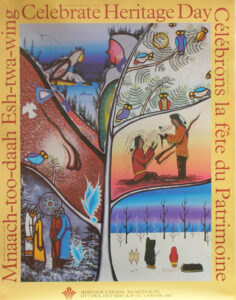
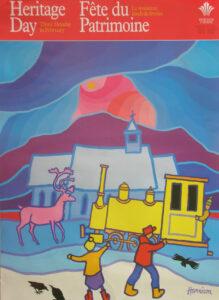
For many years, the National Trust chose a theme for Heritage Day and commissioned a poster, leaving the theme intentionally broad to allow easy use by groups across Canada. For instance, in 2001 the theme was “Travel through time” (which was about cars, trains and boats, rather than time traveling), and in 2015 Canadians were encouraged to “Have Fun with Heritage”. While the poster for 2015 featured short-sleeved revelers on a historic carousel, outdoor fun in frosty February is something else. Other themes have included military heritage, heritage of faith, and the heritage of the everyday.
The National Trust discontinued providing a theme for Heritage Day in about 2016. In recent years, more effort has been put on encouraging people to visit heritage sites during the month of July, when there is a considerably lower risk of frostbite. In many places, a February celebration of heritage is thriving.
While the federal government never adopted the third Monday in February as a holiday, giving a curt wave to heritage by naming February 15 as National Flag Day, many provinces have. These include Ontario, Alberta and Saskatchewan, where it is a statutory holiday known as Family Day.
The federal government has, particularly in the last few years, established a series of days and months to recognize specific cultural communities. Black Heritage Month was one of the first and is celebrated in February. It grew from recognition of Black History Month in 1979 in Toronto, to provincial recognition in 1993, and was adopted by a motion introduced in the federal Senate in 2008. While the singularity of Heritage Day has perhaps waned over the years, the multiplicity of heritage days and months –from Canadian Islamic History Month (October) to Mennonite Heritage Week (second week of September) to Sir John A. MacDonald Day (January 11) and many others — reflect the extraordinary richness of Canada’s cultural mosaic.
Given the dilution of Heritage Day since 1973, is there still something to celebrate? You can bet your beaver lined long johns! Heritage Day continues to provide a platform for Canadians to deepen their understanding of the past. It serves as a reminder of the importance of preserving heritage and it encourages Canadians to take pride in our collective heritage as Canada continues to evolve. It’s a day to celebrate the beauty of culture in all its diversity and the dedicated people who work tirelessly to preserve the value of our past. Happy Heritage Day!