

Where Memory Lives: Exploring the Beothuk Interpretation Centre
On the island of Newfoundland, hidden among a maze of islands and trees, you can find traces of the Beothuk people at the Beothuk Interpretation Centre in Boyd’s Cove. Explore the wooded trails, view archaeological remains from the Beothuk, and leave a token at the Spirit Garden.
Who were the Beothuk?
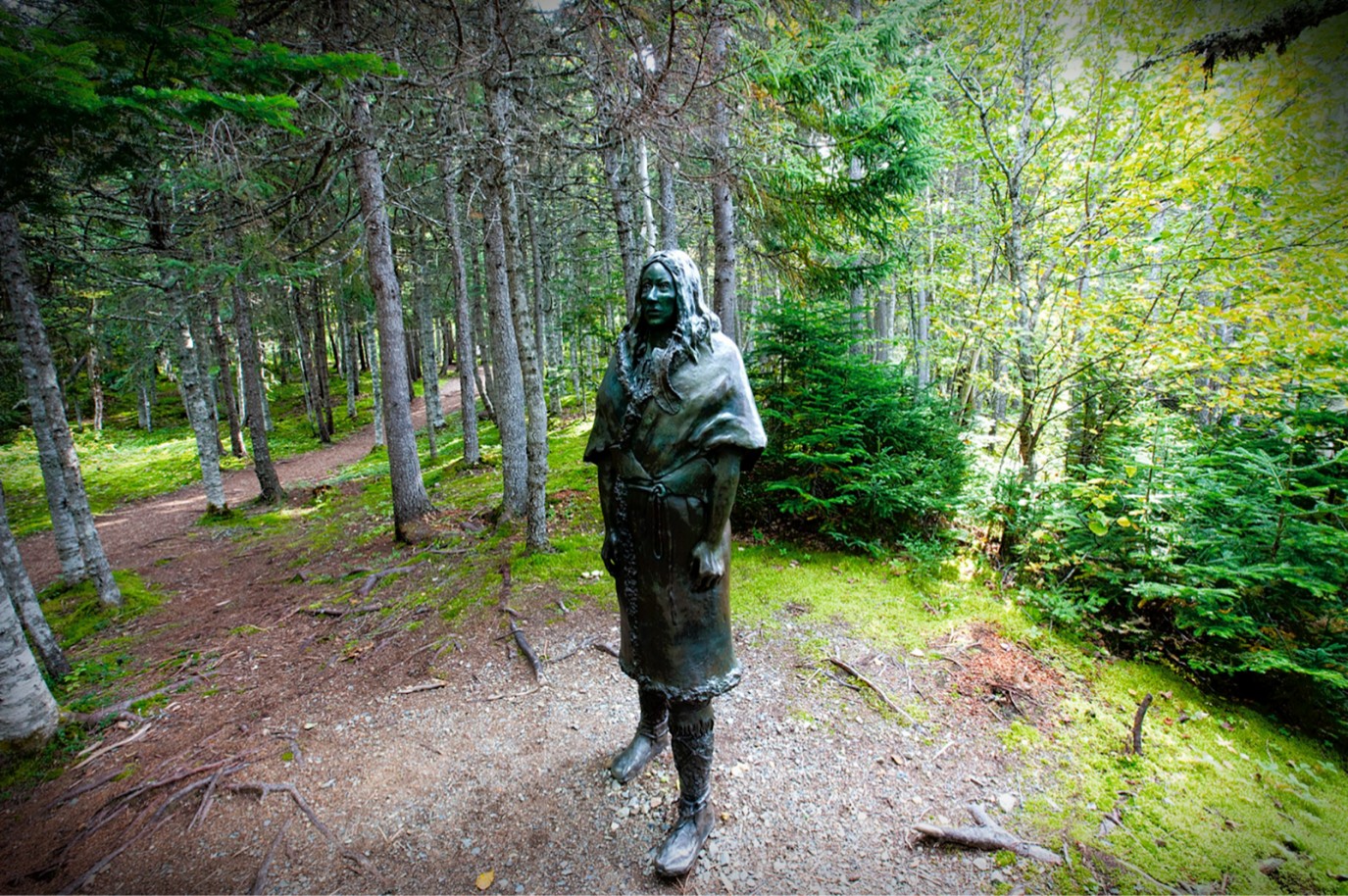
The Spirit of the Beothuk by Gerald Squires is located along the 1.5 km wooded trail at the Beothuk Interpretation Centre. Courtesy of See the Sites, Province of Newfoundland and Labrador.
Beothuk, meaning “the people” or “true people” in their language, lived in the Notre Dame and Bonavista Bay areas of the island of Newfoundland. Their homes, conical dwellings known as mamateeks, were constructed by arranging poles in a circle, tying them at the top, and covering them in birch bark. They were a coastal people. With the arrival of Europeans, the Beothuk were displaced from their traditional living areas and moved inland. The Beothuk’s numbers diminished rapidly following contact, with the last communities gone by 1830.
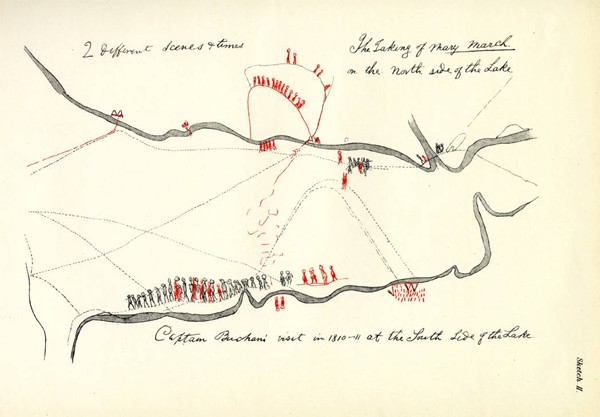
Shanawdithit’s depiction of the taking of her aunt Demasduit, here referred to as Mary March in text added by Cormack, at Beothuk Lake in 1819 on the north side of the lake. Buchan’s 1811 interaction with the Beothuk is depicted on the south side. Courtesy of Memorial University of Newfoundland, Centre for Newfoundland Studies.
How do we know about the Beothuk?
Most contemporaneous accounts of the Beothuk were recorded by Europeans and viewing Beothuk culture through European eyes. The drawings of one Beothuk woman, Shanawdithit, have been invaluable in understanding this distinct culture.
Born in approximately 1800, Shanawdithit was captured by the English in 1823 and eventually brought to William Cormack who sought to record the language and customs of the Beothuk and preserve the culture. The sketches Shanawdithit produced depict Beothuk settlements, tools, and people as well as maps of their territory, including the capture of her aunt Demasduit. Demasduit also contributed to understanding Beothuk culture by recording and translating 180 words. After her death and burial, Demasduit and her husband’s remains were taken to Scotland by Cormack. They were repatriated to Canada in 2020 after 191 years, thanks to the efforts of Chief Mi’sel Joe of Miawpukek First Nation at Conne River who began the process in 2015.
A dozen of Shanawdithit’s drawings are known today. They can be viewed online at the Memorial University of Newfoundland digital collections website.
Celebrating the Beothuk at Boyd’s Cove
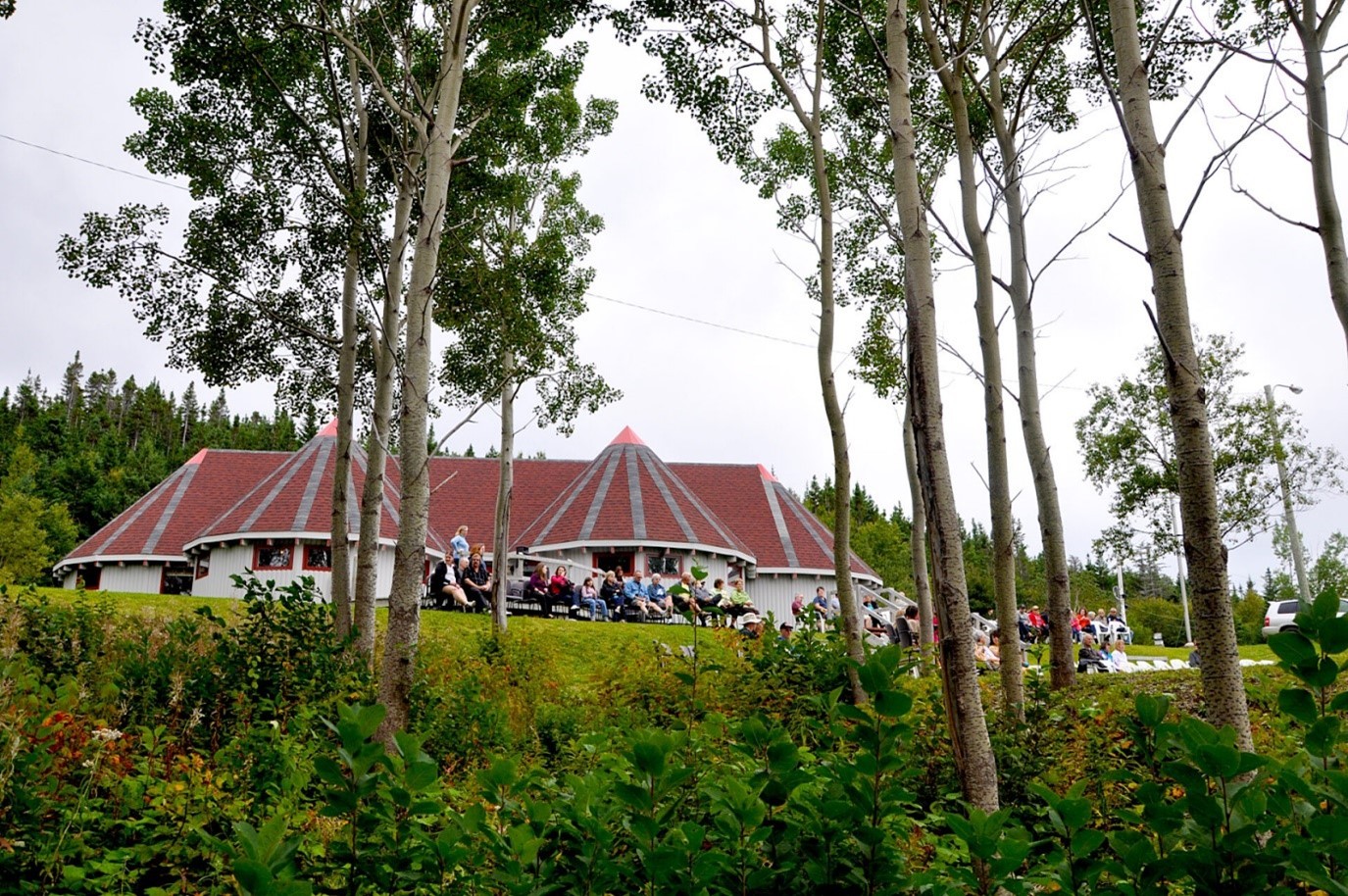
The Beothuk Interpretation Centre, as seen from the Spirit Garden. Courtesy of See the Sites, Province of Newfoundland and Labrador.
The Beothuk Interpretation Centre was inspired by Beothuk mamateeks, traditional birchbark houses constructed by the Beothuk, and continues to honour the memory and legacy of the Beothuk people. Inside the Beothuk Interpretation Centre, learn more about the Beothuk through displays and interpreters before exploring the area surrounding it. One notable feature of the site is the archaeological remains of a Beothuk settlement, featuring the outline of Beothuk dwellings. The site was found in the 1980s following archaeological surveys of the area, and archaeology from the site has produced reworked fishing hooks, stone arrowheads and modified iron nails found in the same stratigraphic layer, bone carvings, and hundreds of tiny smelt bones.
The site is the first to describe the connection between the Beothuk and the Little Passage people, the Beothuk’s pre-contact ancestors, obvious through shared technology. While the archaeological site answered a lot of questions, many still remain. For provincial archaeologist, Jamie Brake, what stands out most about the site is that at Area A, which is where some of the oldest artifacts at the site were found, there is a lot less disturbance at the site than initially thought, meaning there is a lot of future research potential at Boyd’s Cove.
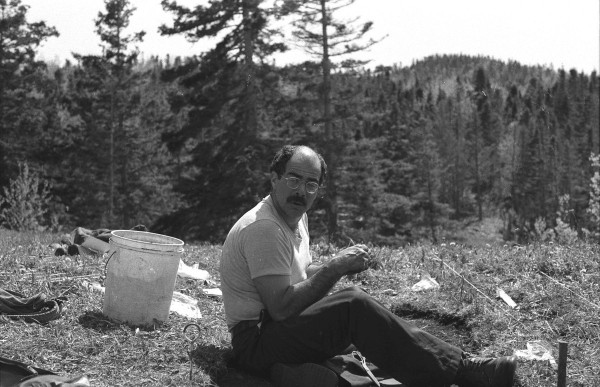
Ralph Pastore, c. 1980 at Boyd’s Cove. Courtesy of Memorial University Newfoundland, Archives and Special Collections.
Ralph Pastore, who led archaeological investigations at Boyd’s Cove, was very involved in the development of the interpretation centre, and wanted it to be a place where visitors can learn about how the Beothuk thrived at Boyd’s Cove. The site represents a peaceful time, and the culture and traditions of the Beothuk are represented on site. Because of Pastore’s meticulous and careful work, much of the site remains intact for future archaeologists to study and excavate as new and improved technologies and techniques emerge.
What to see and do
Visitors to the Beothuk Interpretation Centre can visit the archaeological site and marvel at the outline of the Beothuk dwellings where they once stood, imagining what the site might have looked like 300 years ago.
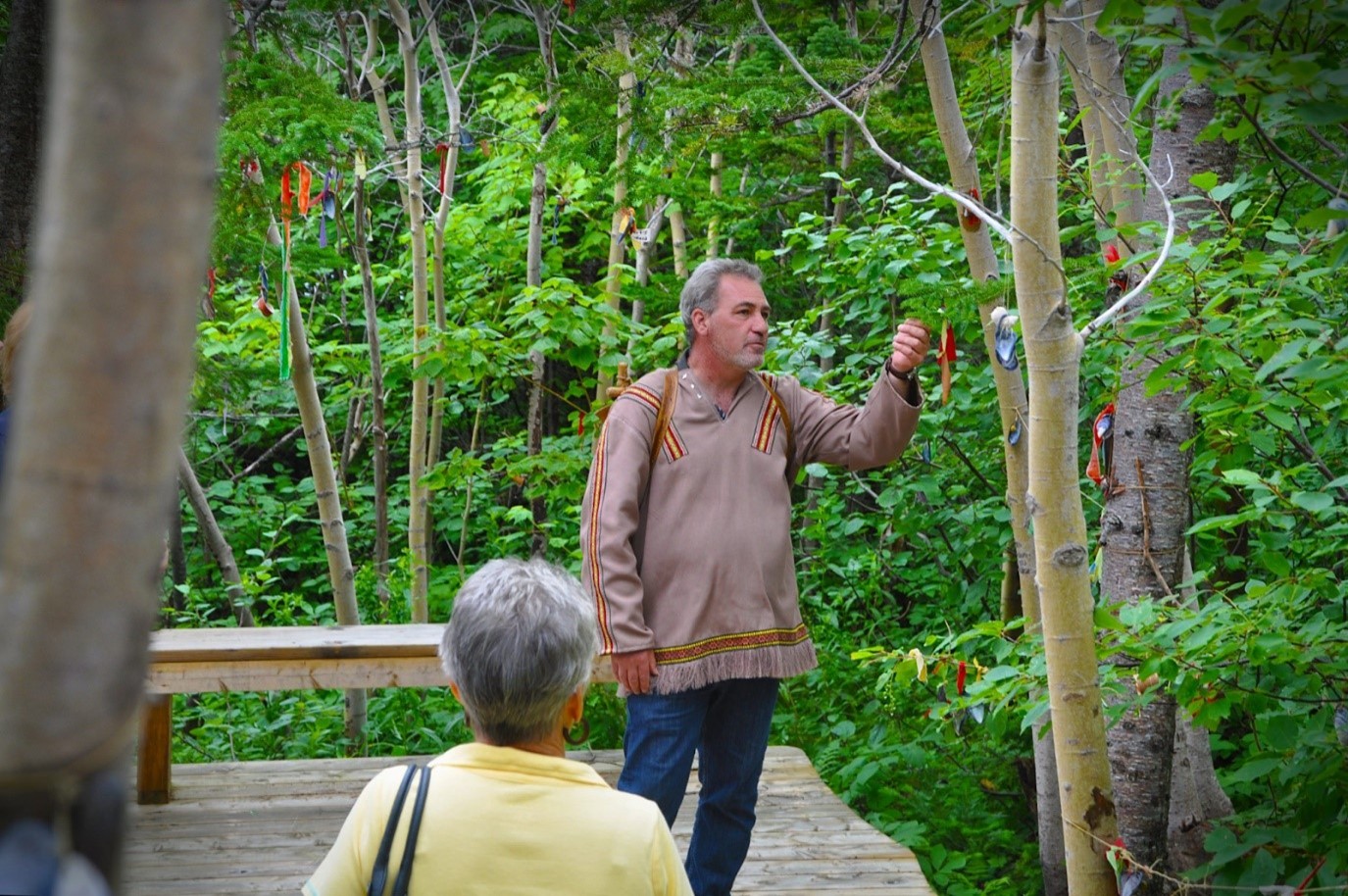
The Spirit Garden, where visitors are encouraged to leave tokens. Courtesy of See the Sites, Province of Newfoundland and Labrador.
Along the 1.5 km trail to the archaeological site, visitors can find a statue in memory of the Beothuk sculpted by local artist Gerald Squires. The placement of the sculpture is particularly important—behind her is a freshwater brook, a source of food (such as smelt) for the Beothuk. In front of her is the archaeological site and the Atlantic Ocean, an important waterway connecting them to other inland territories. According to site supervisor Karen LeDrew, the statue is like the keeper of the site and represents the people as a whole.
You can also visit the Spirit Garden where visitors are encouraged to leave behind a token in memory of the Beothuk. Materials for such tokens are available on site, though visitors can bring their own. The idea for the Spirit Garden came from Mik’maq elder Marie Eastman and in consultation with Indigenous groups across the province. It is described by LeDrew as “a place to go for healing.” She recounts that although many visitors at the Spirit Garden remember the Beothuk, others are thinking of loved ones and family members and have been able to gain closure at the Spirit Garden.
If you go
- The Beothuk Interpretation Centre is located in Boyd’s Cove, NL, about 1 hour from Gander or 4.5 hours by car from St. John’s, on the way to Fogo Island and Twillingate. Turn off Route 340 onto Southside Road and continuing for 2.2km – the road ends in the parking lot.
- The Interpretation Centre is open from mid-May to early October.
- The site features a 1.5 km trail to the archaeological site and a separate Spirit Garden trail.
- Discovery backpacks are available to guide family exploration at the site. All are invited to picnic on the grounds.
The Beothuk Interpretation Centre is part of the Trust’s Passport Places program, a National Trust membership benefit that provides free access to 110 historic places in Canada, as well as 1000+ National Trust places abroad. Become a member today!
This article draws on the following sources:
Tuck, James A. “Beothuk.” The Canadian Encyclopedia, last modified July 22, 2022. https://www.thecanadianencyclopedia.ca/en/article/beothuk
Pastore, Ralph T. “The Boyd’s Cove Beothuk Site.” Heritage Newfoundland and Labrador, last modified 1997. https://www.heritage.nf.ca/articles/indigenous/beothuk-boyds-cove.php
Story, George M. “Shawnadithit.” The Canadian Encyclopedia, last modified July 11, 2022. https://www.thecanadianencyclopedia.ca/en/article/shawnadithit
Mitchell, Alanna. “Amet*: Understanding the Beothuk.” Canadian Geographic, last modified April 14, 2021. https://canadiangeographic.ca/articles/amet-understanding-the-beothuk/
Beothuk Interpretation Centre, Provincial Historic Sites Newfoundland and Labrador. https://www.seethesites.ca/sites/beothuk-interpretation-centre/