



Insurance and Heritage Properties
Insurance is an essential part of contemporary property ownership. Without it, things like getting a mortgage, leasing a building, or running a lunch counter at a house museum are simply not possible. Without access to affordable insurance, the continued ownership, occupation and use of places that have been cornerstones of Canadian communities for generations are threatened. In recent years, however, there have been growing indications that Canada’s heritage and older properties are facing difficulties in obtaining insurance. The National Trust, along with other heritage organizations across the country, is working to address this issue.
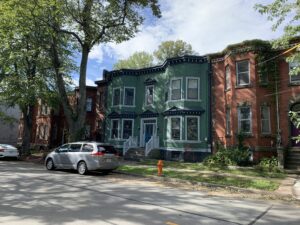
Dr. Martin Murphy House (Halifax, NS) was placed on the Endangered Places List in 2025 due to its struggle to obtain insurance. Credit: Ian Bezanson
BACKGROUND
In mid-2021, the National Trust began to receive reports that insurance policies on heritage properties (designated, inventoried, or simply old) were being cancelled with 24-hours’ notice, not being renewed, or being rejected with no clear rationale. The rise in rates and quote refusals was having knock-on effects. Municipal heritage planners and provincial-territorial heritage officials across the country were reporting mounting queries from property owners about the process for de-designating properties, and it was casting a pall over new designation initiatives, including conservation districts.
Driven by a desire to get beyond anecdotal evidence and gain a cross-country snapshot of the issue, the National Trust conducted a Canada-wide heritage and insurance survey in concert with, Amis et propriétaires de maisons anciennes du Québec (APMAQ), a large association dedicated to owners of heritage properties, was also wrestling with the growing insurance issue. It wrapped up in fall 2022 with the National Trust receiving over 900 responses and APMAQ over 300.
The results from these surveys confirmed that rising insurance rates, coverage cancellation, and quote refusal for heritage designated and older properties (predominantly owner-occupied residential but also commercial and non-profit) were happening unevenly across the country and had been rising since 2020. Between 52 – 61% of respondents had experienced difficulties in obtaining insurance coverage. The surveys also showed that property owners were getting contradictory advice around coverage refusal and rate rises from insurers. This pointed to misunderstandings and inconsistent information as a key irritant. Survey respondents said that insurance companies homed in on particular concerns when refusing coverage: age of building, heritage status, and type/condition of a particular building.
Today, the problem has become so acute that homeowners are concerned about the impact of heritage designation on their ability to access insurance. The insurance problem is undermining the systems put in place to preserve and use historic places.
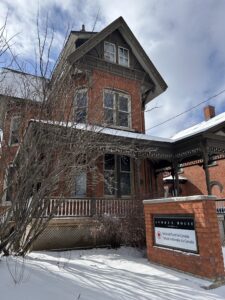
National Trust for Canada offices at 190 Bronson Avenue (Ottawa, ON). Credit: Patricia Kell
WHY IS COVERAGE SOMETIMES HARD TO FIND?
In 2022, not unlike the early-2000s, the Canadian insurance industry was in a challenging market with investment capital tight and increasing claims payouts due to extreme weather events. Insurance companies were going to great lengths to minimize risk of any kind. The result was that any property that has unknown factors or risks – whether real, perceived or misunderstood – were being questioned or rejected. This practice persists today and older buildings, especially designated heritage buildings, have become the victim of this approach.
Heritage properties represent uncertainty and therefore risk to insurers. With their unique designs, older materials and unknown histories, they are seen as a category of buildings with complex, unknown and ultimately unacceptable risk. Buildings with a heritage designation, which may include obligations relating to how repairs are made after a loss and additional administrative hurdles for approval, potentially incur greater costs and delays from the insurance provider’s perspective.
WHAT MUNICIPALITIES CAN DO
- Clarify Heritage Designation Obligations
Better understanding and coordination between insurance companies, brokers and those responsible for municipal heritage designation is needed. A common assumption is that designation requires exact historical reconstruction of a building in the event of damage or loss. In reality, heritage regulations vary widely across jurisdictions and often allow for flexibility in how properties are restored or rebuilt. Many municipal heritage officers report that insurance representatives become open to providing quotes on heritage properties after one-on-one conversations. While this is encouraging, broad system-wide change is needed. Strong plain language statements clarifying heritage designation legal requirements from municipalities, along with provinces and territories, would help clear the fog of misinformation.
- Address the Perception that Designation Means Additional Red Tape
Even with clarity around heritage obligations, the fact of the matter is, designation is seen as an issue by some in the insurance industry as they believe it inserts another interest (the municipality) into any claims process. One potential solution is that municipalities might issue letters to individual insurers/brokers indicating that a heritage permit would not be required in case of full loss of a building on a property.
WHAT HOMEOWNERS CAN DO
Property risk assessment should be based on real evidence – not just assumptions about historic buildings. As with more recent constructions, homeowners need to understand the current state of their building, including its materials and systems. Canada also needs a stronger cohort of appraisers who can knowledgably inspect and assess heritage properties for insurance purposes.
Often homeowners have more success securing a quote from companies that invite a conversation about the home, rather than relying on an online application – which often rejects the application without further consideration once the “Date of Construction” field is filled out. Working with an insurance broker, who has access to several underwriters, may be helpful.
MOVING FORWARD
Since 2025, the heritage community, Insurance Bureau of Canada, and insurance brokers have started working together to try to address the deep structural problems underlying the current crisis in access to home insurance for older buildings. The consequences are serious. In many cities, older buildings are also the most affordable buildings. Not having access to insurance and therefore no mortgage, cuts access to the housing market from those who are most vulnerable.
Gathering of the Heritage Sector: Insurance and Heritage Properties: Review of Survey Findings (2022)
BACKGROUND:
Spotlight on the Problem (Present and Past):
- Le remplacement hâtif des composantes et l’impact des pratiques d’assurance sur l’intégrité patrimoniale (Maisons anciennes du Québec, 9 mai 2024)
- Up for Renewal: Confronting the Insurance Industry’s Problem with Heritage Properties (Locale, March 16, 2023)
- National Trust Gatherings (Video) – Insurance and Heritage Properties: Review of Survey Findings (June 14, 2022)
- National Trust Gatherings (Video) – Insurance Issues at Historic Sites (December 3, 2021); The COVID-19 Crisis and Insurance Issues at Historic Sites (May 27, 2020)
- Insurance Issues at Historic Sites (December 3, 2021)
- Assurer notre patrimoine, un enjeu collectif Renée Genest et Frédérique Lavoie (Continuité Été 2021 • Numéro 169)
- Designation Disrupted by Insurance (Community Heritage Ontario – Winter 2021)
- Insuring Older & Heritage Buildings (Video) (Heritage Trust of Nova Scotia 2021)
- Amis et propriétaires de maisons anciennes du Québec (APMAQ) – Articles on Insurance Issue
- Getting Insurance for your Heritage Property (National Trust – Hēritage, Winter, 2005)
- “What’s Your Policy? Owners Face Insurance Woes On Older Homes,”(National Trust – Hēritage, Spring 2004)
Guidance and Advice Documents:
Jurisdictions and the insurance industry have resources online to inform owners how to deal with obtaining insurance for historic buildings, but the environment is rapidly evolving and the advice (while sound) may not reflect the current industry context.
- Heritage Insuring Heritage Properties: Eight Things You Need to Know (2026) (Insurance Bureau of Canada)
- Heritage Property Risk Prospectus (Insurance Bureau of Canada)
- Heritage Properties: Insuring the Living Past brochure (Insurance Bureau of Canada)
- Insuring Heritage Buildings in Canada: A Brief Overview (Ecclesiastical Insurance)
- Maintaining Your Heritage Property (Ecclesiastical Insurance)
- Heritage Properties and Insurance (2026). (Government of Ontario)
- Insuring Your Registered Heritage Property in Nova Scotia (2024). (Nova Scotia Dept. of Communities, Culture, Tourism, and Heritage)


